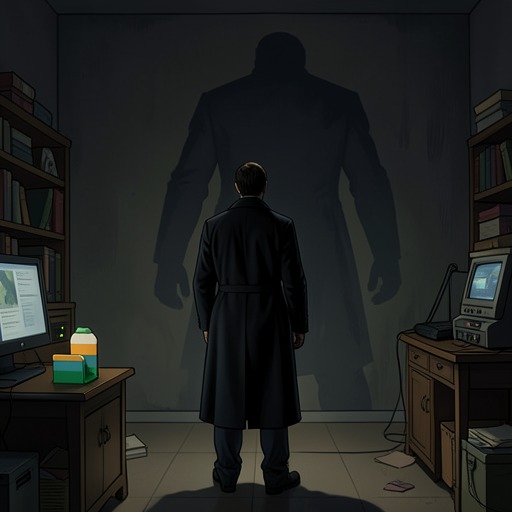
Dead Man Walking
I'm Still Here- What didn't kill me made me stronger and sharperDead Man Walking is the phrase Jensen Brick McCall uses to describe how society sees him: not as a life with a future, but as someone already counted among the dead. Its significance lies in the reversal he builds around it. Jensen’s survival began under an order that he be left to die, yet he comes to understand that survival as a mission, and the search for the person he calls his murderer as a search for his own purpose.
The Identity of a Survivor
The phrase is inseparable from Jensen’s account of a life shaped by abandonment and danger. He describes sleeping on library steps, being raped, living in intolerable conditions, and becoming an unwelcome guest in other people’s homes, where he was reduced to the label of the foster kid. His account does not present the phrase as a literal condition; it expresses the social verdict he feels has been placed on someone whose life has repeatedly been treated as disposable.
That verdict reaches back to his birth. Jensen says his mother attempted to abort him at 26 weeks. After the procedure failed, he was left in a dark room on a table to die; Grace, the nurse who first cared for him, saved his life, while his mother instructed the clinic to let him die. Jensen therefore calls her his murderer, not because she succeeded in killing him, but because her attempted rejection becomes the defining wound through which he understands his existence.
From Abandonment to a Quest
Jensen’s investigation of his birth mother turns the phrase into a starting point for self-understanding. He searches for her online, finds that she has blocked his friend request, and studies the public life she presents: a comfortable home in California with her husband and two children, celebrations, and a beauty salon and spa in Leimert Park. The distance between those images and Jensen’s childhood sharpens the old fantasy that she might once have come to collect him from foster care. He recalls imagining her arriving at school and taking him away, and dreaming of her bringing gifts or offering affection.
The contrast gives the search its emotional force. Jensen is not simply looking for a missing relative; he is confronting the life he believes was withheld from him and the mother whose apparent prosperity sits beside his childhood abandonment. Yet he describes the search as a quest to research his purpose. He hopes that telling his story might help another young man who is trying to understand why he remains alive when death seemed near. The phrase thus shifts from a sentence of social condemnation toward the beginning of a testimony addressed to someone else.
A Reversal in Meaning
Jensen sets society’s judgment against a spiritual interpretation of survival. In society’s eyes, he says, he was dead man walking; in God’s eyes, he was on a mission. He argues that being born means a person is meant to be here, and that what is meant to destroy someone may leave that person stronger and sharper. This does not erase the conditions he has endured. Instead, it changes what those conditions signify: the fact that he was left for dead no longer has the final authority to define his life.
That reframing also changes the meaning of his mother’s place in his story. Jensen says his life began when he left Syracuse, rather than on the day he was left for dead. He does find the woman he calls his murderer, but says the more important discovery of the journey is himself. The expression marks the distance between a life organized around injury and one in which the survivor can name a purpose beyond the injury.
The Phrase’s Final Counterimage
The ending supplies a concrete counterimage to the phrase. One year later, Jensen is seated at the head of a family table. On Christmas Day, Janae Morrison gives birth to their daughter, Grace Pearl McCall; Jensen identifies Janae as his wife and best friend and says that he has a family. The woman once called his murderer is now his mother, and he has donated a kidney so she can watch his brother and sister grow up.
The change is not presented as a denial of the original abandonment. The attempted abortion remains part of the family’s history, but it no longer dictates the relationship’s ending. Against the image of someone already dead, the final scene places Jensen among people he loves, taking responsibility for them and helping make their continued life possible. Dead Man Walking therefore names both the stigma from which his story begins and the identity his ending overturns: he is not merely the child who survived another person’s decision, but a husband, father, son, and caregiver whose life has become a source of connection.